
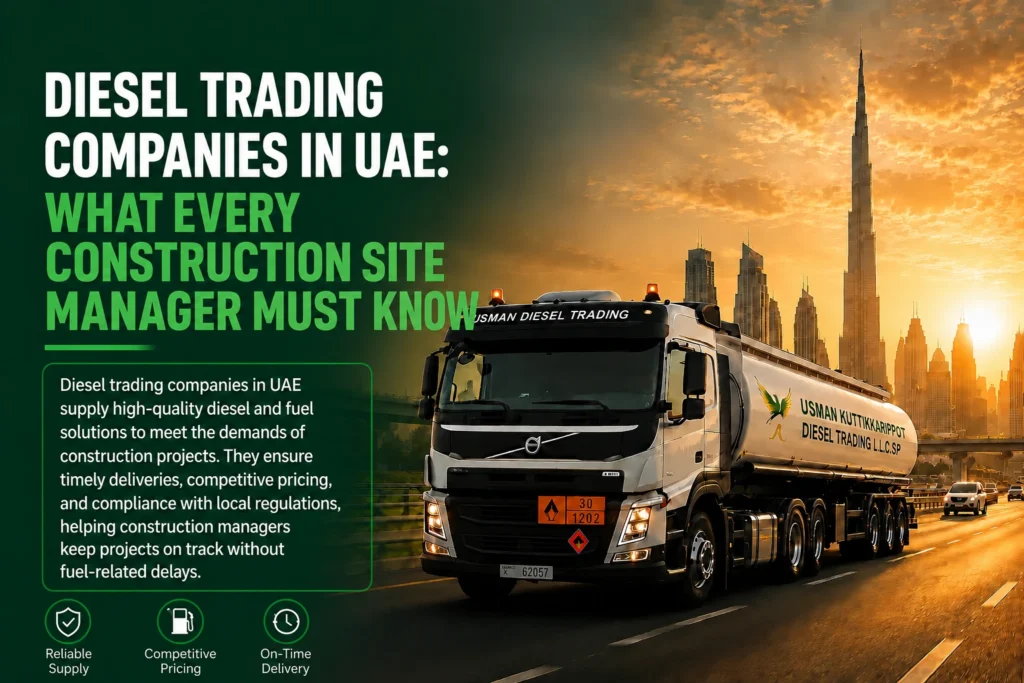
On an active construction site in Dubai or Sharjah, a single fuel outage can bring everything to a halt; excavators go silent, cranes stop mid-operation, generators cut power to site offices and lighting. The role of diesel trading companies in UAE goes far beyond just delivering fuel; they are a critical link in every construction project’s operational chain. Here is exactly how the best-run sites manage it, and what to look for in a fuel supply partner.
The Real Fuel Numbers Behind an Active UAE Construction Site
Before making a decision among diesel trading companies in Dubai and Sharjah, it is important to know how much diesel is actually needed at your particular site. The amount burned by a busy job site in either of the cities is considerable.
For example, a big excavator used for eight-hour shifts consumes around 25-40 litres of diesel per hour. Tower cranes in motion take from 10 to 20 litres of diesel per hour as well. And this does not take into account the need for concrete mixers, compressors, dewatering pumps, and generators supplying the required electricity for your job site.
| Equipment Type | Estimated Consumption | Daily Total (8hr shift) |
| Large excavator | 25–40 litres/hour | 200–320 litres |
| Tower crane (under load) | 10–20 litres/hour | 80–160 litres |
| Concrete mixer truck | 15–25 litres/hour | 120–200 litres |
| Site generator (100kVA) | 20–25 litres/hour | 160–200 litres |
| Dewatering pump | 5–10 litres/hour | 40–80 litres |
What Happens to a Construction Site When the Diesel Runs Out
The unintended consequences of running out of diesel: When diesel is unavailable on a construction site, it is more than just the construction machines that come to a standstill. Workers will have to remain idle, causing delays in the project timeline. Work that needs to be subcontracted becomes delayed due to inaction. There might even be penalties assessed in the event of a fuel shortage. One unexpected stop in fuel supply can lead to a loss of several weeks’ worth of fuel supply costs on a major construction site.
Because fuel supply volumes as well as quality are sometimes inadequate, construction companies in the Emirates have to deal with stalled cranes, excavators, and generators on their sites as a result of fuel running out.
Below are the seven steps that construction companies in the UAE need to take in order to avoid fuel-related downtime.
1. Know Your Daily Fuel Demand Before You Place a Single Order
Reliable fuel management starts with accurate consumption forecasting. This is not guesswork; it is a straightforward calculation based on your equipment roster and shift schedule, and it is the first thing that experienced site managers discuss when evaluating which of the available diesel trading companies in UAE can genuinely meet their volume needs.
2. Set a Fuel Threshold That Triggers Re-orders Before You Hit Zero
Minimum stock levels refer to the levels where a re-order should be initiated before the tank empties out instead of after it becomes empty. Effective site managers in Dubai and Sharjah, on the other hand, usually set their minimum in the range of 30-40% of the tank’s total capacity, which is sufficient to have at least two days of operational consumption buffer.
This buffer safeguards against delays incurred as a result of an increase in traffic, unexpected surges in demand, or issues caused by a supplier’s inability to deliver. The rule is quite simple. Most of the time, once the stock is reduced to the minimum stock level, a delivery is ordered regardless of any workload that week.
3. Why Diesel Trading Companies in UAE Must Deliver Directly to Your Site
Not all diesel trading companies in UAE serve construction sites the same way. There is a meaningful operational difference between a supplier who delivers to a depot for collection and one who brings a tanker directly onto your site, navigates the access constraints of an active construction zone, and coordinates with your site manager on timing.
Construction companies need bulk diesel suppliers with direct site delivery capability, along with the logistical experience to navigate active construction zones, coordinate with site managers, and deliver on schedule regardless of site access complexity.
6 Things to Check Before Signing with Any Fuel Supplier
- Own tanker fleet – The most reliable diesel trading companies in UAE own their delivery vehicles rather than depending on third-party transport, which introduces scheduling variables outside their control.
- Construction site delivery experience – understanding of site access protocols, safety requirements, and coordination with site managers
- Coverage across Dubai and Sharjah – essential if your projects span both emirates
- 10 PPM diesel supply – the grade required by modern construction equipment
- Valid UAE trade licence – confirming they are a properly licensed operator, not a broker
Licensed diesel trading companies in UAE control the entire supply chain; from the moment diesel leaves the terminal to the moment it enters your storage tank. That end-to-end control is what makes reliable, on-schedule delivery possible, and it is the clearest distinction between a professional trading company and an informal reseller.
4. Stop Splitting Orders – One Trusted Supplier Outperforms Three Average Ones
Choosing to work with many small suppliers might seem like a good way to create competition in fuel supply, but it leads to documentation hassles, inconsistency in fuel quality, and lowered priority in each of the suppliers.
Consolidating with any of the well-known diesel trading companies in UAE, which can fulfill your full volume of fuel needs, ensures you get the best service, increased accountability, and cleaner audit trails. When a supplier handles the entire fuel requirement for you, it becomes familiar with your site, schedule, and consumption habits, ensuring quicker response to urgent calls and greater delivery flexibility.
5. Schedule Deliveries Around Your Site – Not Around Your Supplier’s Convenience
Active construction sites in Dubai and Sharjah operate within specific access constraints. Heavy vehicles, including diesel tankers, are often restricted from entering certain areas during peak working hours when equipment is in motion, concrete is being poured, or lifting operations are underway.
The most efficient approach is to plan deliveries around your site’s natural access windows – typically early morning before primary operations begin, during the midday break, or at the end of shift. Share these windows clearly with your supplier so they can schedule accordingly, and build in enough lead time that a delayed delivery does not compromise that day’s operations.
4 Practical Steps for Smoother On-Site Delivery Coordination
- Designate a specific fuel storage point on site that tankers can reach without crossing active working areas
- Assign one person on site as the fuel delivery contact; the supplier always knows who to call
- Confirm deliveries the morning before they are due, not the morning of
- For large sites, consider a fixed weekly delivery schedule with a standing top-up order
6. Never Accept a Delivery Without a Certificate of Quality
Receiving the wrong grade of diesel or fuel that has been contaminated during storage or transport can damage modern construction equipment without any immediate visible sign. The problem often surfaces weeks later through increased fuel consumption, unexpected filter blockages, or engine performance issues that trace back to substandard fuel.
Reputable diesel trading companies in UAE provide a Certificate of Quality with every bulk delivery, confirming sulphur content and fuel grade. If your current supplier cannot produce this documentation on request, that is a red flag worth acting on before a costly equipment issue forces your hand.
7. Keep a Fuel Log – It Saves Money and Protects You at Audit Time
A fuel log is a simple record of every delivery received — the quantity, the date, the supplier, and which tank or equipment the fuel was allocated to. It takes two minutes to update after each delivery and pays back far more than that in time saved later.
For construction companies, a well-kept fuel log does four things:
- Consumption tracking – when actual usage consistently exceeds your forecast, it usually points to a specific piece of equipment running inefficiently or fuel being misallocated on site
- Project cost allocation – accurate per-delivery records let you assign fuel costs to individual projects, which improves your tendering accuracy and protects your margins
- Supplier accountability – if a delivered quantity does not match the order, your log is the evidence. Without it, the dispute is your word against theirs
- VAT and regulatory compliance – UAE construction contracts increasingly require documented fuel procurement records. A complete log means you are audit-ready at any point, not scrambling when a request comes in
The most professional diesel trading companies in UAE support this process automatically — providing delivery notes, COQ certificates, and VAT-compliant invoices with every order. If your current supplier does not, ask why.
Sharjah vs Dubai Construction Sites – Why Your Supplier’s Location Changes Everything
When evaluating diesel trading companies in UAE for your construction project, the emirate your site is located in matters more than many contractors realise.
Sharjah has a much greater density of industrial zones than either Dubai or Abu Dhabi. From Al Sajaa to Hamriyah to SAIF Zone, construction activity is often concentrated within or adjacent to established industrial corridors. A Sharjah-based diesel supplier can frequently reach construction sites within the emirate faster than a Dubai-based equivalent, with fewer cross-emirate logistics complications and lower embedded delivery costs.
Dubai’s construction sites, particularly those in active development zones such as Dubai South, Mohammed Bin Rashid City, and the waterfront districts, often face tighter access restrictions and more complex logistics for fuel delivery. Choosing a supplier with specific experience navigating Dubai’s construction zone requirements makes a noticeable difference in delivery reliability.
For contractors managing projects across both emirates simultaneously, working with diesel trading companies in UAE who have confirmed coverage across Dubai and Sharjah under a single supply agreement simplifies procurement, documentation, and supplier management significantly.
Construction Site Diesel Supply – Your Questions Answered
What Do Diesel Trading Companies in UAE Actually Deliver to Construction Sites?
Licensed diesel trading companies in UAE supply bulk diesel fuel, typically 10 PPM ultra-low sulphur diesel, directly to construction sites via their own tanker fleet. This includes scheduled top-up deliveries, emergency fuel supply, and on-site delivery coordination with site managers.
How Frequently Should a UAE Construction Site Receive Bulk Diesel?
This depends on your daily consumption and storage tank capacity. Most mid-to-large construction sites in Dubai and Sharjah find that two to three deliveries per week maintains an adequate buffer without requiring excessive on-site storage. Sites with higher consumption or limited storage may need daily deliveries.
Which Diesel Grade Do UAE Construction Machines Actually Require?
Modern construction machinery- excavators, cranes, concrete mixers, and generators manufactured in the last ten to fifteen years- is designed to run on 10 PPM ultra-low sulphur diesel (ULSD). Using a higher-sulphur grade risks engine damage and can void manufacturer warranties.
How Can I Check if a Diesel Trading Company in UAE Is Properly Licensed?
Ask for their UAE trade licence number and the issuing authority – either the DED (Department of Economic Development) in Dubai or the equivalent emirate-level authority. Reputable diesel trading companies in UAE will share this documentation without hesitation. You can also verify licences through the relevant emirate’s business registration portal.
The Right Diesel Trading Company Makes or Breaks Your Project Schedule
The UAE has no shortage of diesel trading companies willing to supply your site. What separates a reliable supply partner from an unreliable one is not the product; diesel is diesel – it is the infrastructure, the documentation, the direct delivery capability, and the consistency of service when your project is under time pressure.
The seven strategies in this guide are what experienced construction operators across Dubai and Sharjah use to keep their sites running without fuel-related disruption. Apply them, and partner with diesel trading companies in UAE who can match your site’s operational demands – not just the volume, but the timing, the quality documentation, and the direct delivery capability that a well-run site requires.
Forecast accurately. Set your minimum stock level. Choose a supplier who owns their tankers and delivers directly to site. Document every delivery. That combination keeps your equipment running and your project on schedule.